
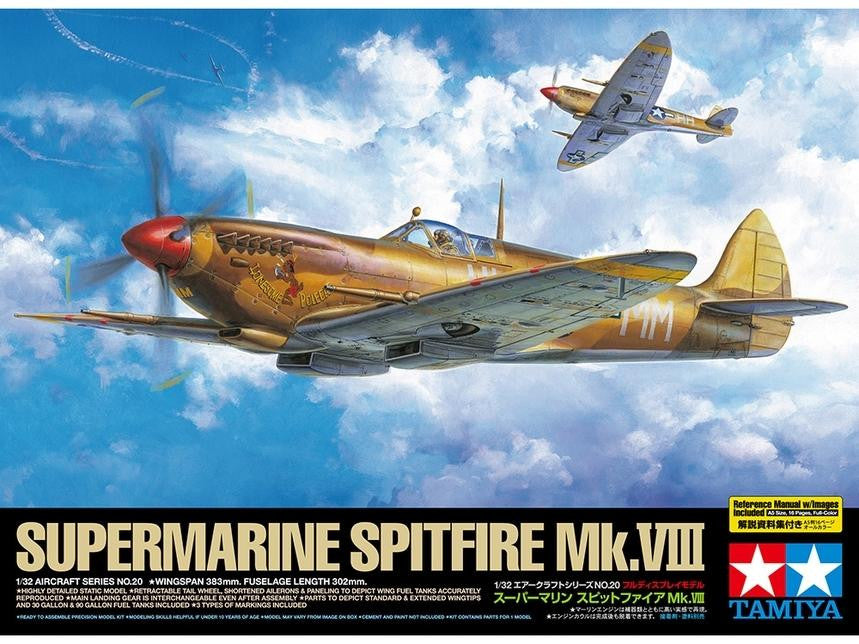
The legendary Spitfire was the representative British fighter of WWII. Many variants were built and among these was the Mk.VIII, a variant developed to be the replacement for the RAF's previous mainstay Spitfire, the Mk.V. The Mk.VIII was fitted with a Rolls-Royce Merlin 60-series engine, larger radiators, and an air filter as standard. Other improvements included fuel tanks added in the wings, retractable tail wheel, shortened ailerons, and enlarged rudder and elevators. From the latter half of 1943, the Mk.VIII were deployed to the Mediterranean and Pacific Theaters and saw service with RAF, USAAF, RCAF, and RAAF units.
1/32 scale plastic assembly kit of the Spitfire Mk.VIII. _x0098_ _x0085_Overall Length: 302mm, Overall Width: 383mm. _x0098_ _x0085_Features of the Mk.VIII, including the retractable tail wheel, shortened ailerons, and wing fuel tanks, have all been accurately reproduced. _x0098_ _x0085_You can select either retracted or deployed landing gear and tail wheel even after assembly. _x0098_ _x0085_Parts to depict standard and extended wingtips included _x0098_ _x0085_Features moveable ailerons, rudder, and elevators. Flaps can be depicted in either up or down position. _x0098_ _x0085_Parts for 30 and 90 gallon fuel tanks included. _x0098_ _x0085_Comes with 3 kinds of markings to depict the aircraft from USAAF, RAAF, and RCAF units. _x0098_ _x0085_Comes with 2 pilot figures, 1 seated and 1 standing.
Skip to product information
Tamiya · Mk.VIII development (Japanese)
RAF Air Power Review · Spitfire development
Tamiya 60320 · aircraft and markings


AK 3G AIR · WWII RAF Desert Colors
AK Real Colors · WWII RAF Desert Colors
 Sprue Cutter High Grade Pointed 74123
 Extra Thin Cement 40ml 87038
 Flex Pads Set w/Flex-i-File 550
 Masking Tape w/ Dispenser 10mm 87031
 Straight Tweezer 74004
 Formula 560 Canopy Glue
Explore this aircraft Design preview
A Spitfire built for a wider war
When the Focke-Wulf Fw 190 appeared in 1941, it gave Spitfire Mk.V pilots a dangerous new opponent. The Mk.VIII was developed to carry the Spitfire forward, pairing a Merlin 60-series engine with a more extensively revised airframe. But those refinements took time: the quicker-developed Mk.IX became the mainstay in Europe while the Mk.VIII was still coming into production.
Follow its story
From 1943, the Mk.VIII served in the Mediterranean and Pacific with British, American, Canadian and Australian units. Extra wing fuel tanks, a retractable tailwheel and revised flying surfaces distinguished it from earlier Spitfires. Its story takes that familiar silhouette far beyond the skies of southern England.
This kit captures that wider Allied story. The American and Canadian subjects depict aircraft in Italy in early 1944; the Australian option is Wing Commander Bobby Gibbes’s shark-mouthed “Grey Nurse” at Morotai in 1945. The U.S. stars and Canadian roundels sit over the same British desert camouflage: a different aircraft identity and setting, with the same basic palette.
History sources
Tamiya · Spitfire Mk.VIIITamiya · Mk.VIII development (Japanese)
RAF Air Power Review · Spitfire development
Tamiya 60320 · aircraft and markings
Kit Instruction Colors
View kit instructions (PDF)
![]() Find a Similar Color
![]() Find a Similar Color
![]() Find a Similar Color
![]() Find a Similar Color
![]() Find a Similar Color
![]() Find a Similar Color
![]() Find a Similar Color
![]() Find a Similar Color
![]() Find a Similar Color
![]() Find a Similar Color
![]() Find a Similar Color
![]() Find a Similar Color
![]() Find a Similar Color
![]() Find a Similar Color
![]() Find a Similar Color
![]() Find a Similar Color
![]() Find a Similar Color
![]() Find a Similar Color
![]() Find a Similar Color
![]() Find a Similar Color
![]() Find a Similar Color
![]() Find a Similar Color
![]() Find a Similar Color
![]() Find a Similar Color
![]() Find a Similar Color
![]() Find a Similar Color
![]() Find a Similar Color
![]() Find a Similar Color
![]() Find a Similar Color
![]() Find a Similar Color
![]() Find a Similar Color
![]() Find a Similar Color
![]() Find a Similar Color
![]() Find a Similar Color
![]() Find a Similar Color
![]() Find a Similar Color
![]() Find a Similar Color
![]() Find a Similar Color
Tamiya’s original paint callouts, with their own selection and cart controls. For the U.S. and Canadian aircraft shown below, the manual specifies XF-52 + TS-46 upper colors and an XF-8 : XF-2 underside mixture of 1 : 3. The full list also covers details and other kit options; choose only what your build needs.
Build This Model
The 38 paints are from the assembly manual. AS-30, AS-31 and AS-32 are the RAF camouflage colors. TS-46 light sand starts unchecked for optional details; follow the marking guide and mixes.
Paints (38)
0 items selected
Tools and supplies (8)
Select any tools you need to add them with your paint selection.
Checking supply availability…
Paints and supplies sold separately. Prices and availability update from each product.
Historical Paint Schemes
Choose a specific aircraft, then shop our suggested main camouflage paints. These recommendations are separate from Tamiya’s instruction paint list.
“Lonesome Polecat” · HL-MM
Lt. Bill Skinner · 308th Fighter Squadron, 31st Fighter Group · Castel Volturno, Italy · February 1944, as depicted by Tamiya.
JF579 · AN-J
No. 417 Squadron · Marcianise, Italy · January 1944, as depicted by Tamiya.
Markings included in this kit
Both aircraft use the same British desert palette; their national markings differ.
Each option is a separate shopping list. Out-of-stock paints remain visible and cannot be selected. Only selected, available paints are added; there is no bundle discount.
Water-based acrylic pack · use thinner intended for AK 3G paints.
Lacquer pack · use appropriate lacquer thinner and ventilation. This is a different paint system from water-based acrylics.

Dark Earth
Upper-surface camouflage
AK11841
$5.49 In stock
View paint

Middle Stone
Upper-surface camouflage
AK11846
$5.49 In stock
View paint

Azure Blue
Undersides
AK11845
$5.49 In stock
View paint

Dark Earth
Upper-surface camouflage
RC961
$5.49 In stock
View paint

Middle Stone
Upper-surface camouflage
RC966
$5.49 In stock
View paint

Azure Blue
Undersides
RC965
$5.49 In stock
View paint
Manufacturer’s RAF desert palette: Dark Earth 71.323, Middlestone 71.031 and UK Azure Blue 71.108. Use thinner intended for Model Air.
The older 10 ml Real Colors bottles: RC287 Dark Earth, RC292 Middle Stone and RC291 Azure Blue. Same range and paint base as the larger-bottle option; use suitable lacquer thinner and ventilation.
C369 RAF Dark Earth, C21 Middle Stone and C370 Azure Blue. Manufacturer paint callouts for the RAF desert scheme; use Mr. Color-compatible thinner and ventilation. Out-of-stock colors stay visible.
Tamiya X/XF solvent-based acrylics, five bottles. Dark Earth: XF-52 straight. Middle Stone: 1 part XF-59 + 1 part XF-60. Azure Blue: 1 part XF-8 + 3 parts XF-2. Mix by volume. The Middle Stone recipe comes from Tamiya’s Spitfire Mk.Vb Trop instructions; Dark Earth and Azure Blue follow this Mk.VIII kit. These are documented recipes, not a separate list of this kit’s exact instruction colors. Use thinner intended for Tamiya X/XF acrylics.
Water-based acrylic. Earlier Vallejo RAF desert guidance used 71.029 Dark Earth with 71.031 Middlestone and 71.108 UK Azure Blue. Current guidance uses 71.323 instead; the two Dark Earth paints are not presented as identical tones.
Lacquer. C22 Dark Earth, C21 Middle Stone and C370 Azure Blue are another documented Spitfire Mk.VIII desert palette. C22 and the other option’s C369 are different Dark Earth paints; they are not presented as identical tones. Use Mr. Color-compatible thinner and ventilation.
Main exterior camouflage only. Cockpit, propeller, detail colors and markings are not included. Some options require mixing as described above.
View Tamiya’s painting guide
Tamiya’s researched historical interpretation. These recommendations use manufacturer color references and documented recipes; they are not independently measured exact matches. Follow the kit diagram for the pattern.
Tamiya 60320 · View Tamiya’s painting guideAK 3G AIR · WWII RAF Desert Colors
AK Real Colors · WWII RAF Desert Colors
Tools for this build
LionHeart’s practical suggestions for this 1/32 kit. Use what you already own; the products below are examples, not a required shopping list.
Core bench tools
Sprue cutters
 Sprue Cutter High Grade Pointed 74123
Remove the fine cockpit and engine parts cleanly from the runners.
$49.99In stock
View product
Plastic cement
 Extra Thin Cement 40ml 87038
For unpainted polystyrene joints. Keep solvent cement away from clear glazing.
$6.25In stock
View product
Fine sanding tools
 Flex Pads Set w/Flex-i-File 550
Smooth attachment points and fuselage seams while protecting surface detail.
$34.98In stock
View product
Helpful extras
Masking tape
 Masking Tape w/ Dispenser 10mm 87031
Protect canopy glazing and define camouflage boundaries; cut to suit the glazing panels.
$6.68In stock
View product
Fine tweezers
 Straight Tweezer 74004
Position small cockpit details and handle decals with more control.
$10.99In stock
View product
Canopy glue
 Formula 560 Canopy Glue
A dedicated adhesive option for the clear canopy. Follow its application and drying directions.
$4.99In stock
View product
Recommendations are based on the build, not a manufacturer-required tool list.





1/32 Spitfire Mk.VIII 60320
Regular price
$199.00