

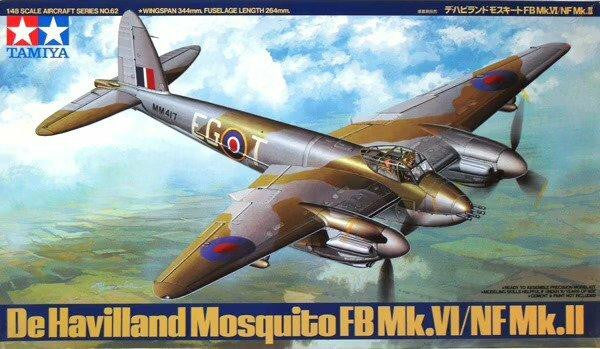
Nicknamed "The Wooden Wonder" due to its nearly all-wood construction, the de Havilland Mosquito was initially conceived as a fast, unarmed bomber and went on to serve in that and many other roles during WWII. This kit depicts the NF Mk.II nightfighter and FB Mk.VI fighter-bomber variants which were introduced in Spring 1942 and Spring 1943 respectively. Parts are included for the NF Mk.II's nose- and wing-mounted radar antenna as well as 500lb bombs and rockets for the FB Mk.VI. The bomb bay may be fitted with bombs and also features details for the fuel tank and 20mm cannon magazines. Two pilot figures and three marking options are included.
Skip to product information
The story behind your model New guide preview
Mosquito: the wooden fighter-bomber
The Mosquito made speed its first line of defence. Designed as a fast bomber without defensive gun turrets, it used a lightweight wooden structure: thin birch plywood skins around a balsa core in the fuselage. The prototype first flew on 25 November 1940. That combination of speed and carrying capacity proved adaptable enough to create an entire family of bombers, reconnaissance aircraft and heavily armed fighters.
Read the full story
This kit captures two of the family’s fighting forms. The NF Mk.II took radar and concentrated forward-firing armament into the night-fighter role during 1942. The FB Mk.VI combined four .303-inch machine guns and four 20 mm cannon with bombs or rockets. Its compact gun nose made it a formidable low-level attacker, while the two-man crew divided the demanding work of flying, navigation and fighting.
The model’s camouflage can tell very different stories. MM417, EG-T, of No. 487 (New Zealand) Squadron was photographed carrying underwing bombs while based at Hunsdon in February 1944. The alternative all-black W4087, RS-B, belongs to No. 157 Squadron’s early night-fighter story. Choose the aircraft before assembly: the radar aerials, weapons and finishing instructions distinguish the NF Mk.II from the FB Mk.VI.
Sources and accuracy
Tamiya 61062 instructions; RAF Museum: the Wooden Wonder; IWM: Mosquito MM417
Kit Instruction Colors
View kit instructions (PDF)
![]() Find a Similar Color
![]() Find a Similar Color
![]() Find a Similar Color
![]() Find a Similar Color
![]() Find a Similar Color
![]() Find a Similar Color
![]() Find a Similar Color
![]() Find a Similar Color
![]() Find a Similar Color
![]() Find a Similar Color
![]() Find a Similar Color
![]() Find a Similar Color
![]() Find a Similar Color
![]() Find a Similar Color
![]() Find a Similar Color
![]() Find a Similar Color
![]() Find a Similar Color
![]() Find a Similar Color
![]() Find a Similar Color
![]() Find a Similar Color
![]() Find a Similar Color
![]() Find a Similar Color
![]() Find a Similar Color
![]() Find a Similar Color
![]() Find a Similar Color
![]() Find a Similar Color
![]() Find a Similar Color
![]() Find a Similar Color
These are the kit manufacturer’s paint recommendations. Follow the exact instruction diagrams for placement, marking choices and mixes. They are separate from the historical palettes below.
Build This Model
The palette includes all three manual schemes. Scheme A uses AS-9, AS-10 and AS-11; B uses XF-54 and XF-55; night fighter C uses TS-6. B/C exterior paints start unchecked. Interior green mixes XF-5:1 + XF-21:3 + XF-65:1; landing-gear tanks use XF-7:5 + XF-9:1. XF-23 and XF-24 are also needed for a 1:1 radio detail mixture. Scheme B spinners use XF-2:3 + XF-23:1. Follow all local mixture callouts in the manual. Supplies are optional and start unchecked. X-20A thinner is for Tamiya X/XF acrylic bottles, not the AS/TS sprays.
Paints (28)
0 items selected
Tools and supplies (8)
Select any tools you need to add them with your paint selection.
Checking supply availability…
Paints and supplies sold separately. Prices and availability update from each product.
Historical Paint Schemes
Choose a documented aircraft or vehicle finish, then a paint system. These researched alternatives are separate from the instruction list above.
Each pack is its own shopping list. Choose one paint system; selections stay separate. Out-of-stock items remain visible but cannot be added. There is no bundle discount.
Exterior scheme colors only. Check the diagrams for pattern and placement. Interior, crew, small details and decals are not included unless a pack explicitly says so. Model paints are manufacturer-intended reproductions or labeled approximations, not independently measured exact historical matches.
Sources and accuracy
Tools for this build
Practical suggestions for assembling and finishing this kit. Buy only what you need; nothing here is added automatically.
Build basics
Loading current prices and availability…
Useful extras · optional
Loading current prices and availability…
Choose glue for the material and thinner for the paint range. A shared base type alone does not guarantee different brands can be mixed together.






1/48 Mosquito FB.MkVI 61062
Regular price
$47.99