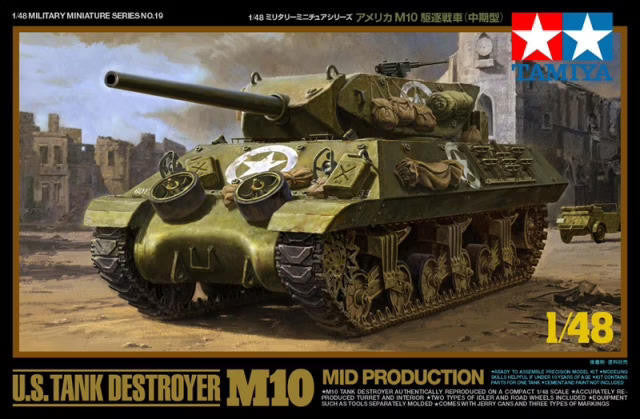
The M10 was a purpose-built answer to the U.S. Army's search for a mobile anti-tank weapon. Officially the 3-inch Gun Motor Carriage M10, it used the diesel-powered M4A2 Sherman's automotive foundation but replaced the tank's heavily enclosed turret with a lower, open-topped fighting compartment carrying a 3-inch gun. The intention was to move quickly to threatened sectors, engage enemy armor and shift position, rather than trade blows behind the thickest possible protection.
Read the full story
Its shape reveals those priorities. Sloping hull sides and the angular turret helped keep weight down, while an open roof gave the crew a broad view and room to work. That visibility came at a cost: artillery fragments, small-arms fire and bad weather could reach the fighting compartment. The long gun also created a balance problem, addressed through turret counterweights. This mid-production subject captures the distinctive configuration of an M10 rather than the later British 17-pounder conversion.
In practice, M10 crews did far more than wait for enemy tanks. They supported infantry, attacked strongpoints and undertook artillery-style fire missions as the fighting demanded. Tamiya's three vehicles place the type across the 1944 campaign: Normandy, the landings in southern France and the fighting at Aachen. Their common Olive Drab finish is distinguished by different stars, tactical markings and unit codes, allowing the model to tell a specific battalion's story.
Sources and accuracy
Tamiya 32519 instruction manual; DITSONG National Museum of Military History: American Tank Destroyers; West Point Modern War Institute: Battle of Aachen
These are the kit manufacturer’s paint recommendations. Follow the exact instruction diagrams for placement, marking choices and mixes. They are separate from the historical palettes below.
Build This Model
These 12 paints come from the exact Tamiya 32519 instruction manual, including interior and equipment details. XF-62 Olive Drab starts selected; TS-5 is the alternate spray body finish and starts unchecked. Follow the diagrams for placement.
Select any tools you need to add them with your paint selection.
Checking supply availability…
Paints and supplies sold separately. Prices and availability update from each product.
Historical Paint Schemes
Choose a documented aircraft or vehicle finish, then a paint system. These researched alternatives are separate from the instruction list above.
Each pack is its own shopping list. Choose one paint system; selections stay separate. Out-of-stock items remain visible but cannot be added. There is no bundle discount.
Exterior scheme colors only. Check the diagrams for pattern and placement. Interior, crew, small details and decals are not included unless a pack explicitly says so. Model paints are manufacturer-intended reproductions or labeled approximations, not independently measured exact historical matches.
Sources and accuracy
Tools for this build
Practical suggestions for assembling and finishing this kit. Buy only what you need; nothing here is added automatically.
America's first tank destroyer, the M10 was mounted on a Sherman hull and had an open-topped turret carrying a 3-inch (76.2mm) cannon capable of penetrating 8.8cm of armor at 1000m distance. Due to the need for high mobility, the M10 wore relatively thin armor plating. However, auxiliary armor could be added easily using the bolts located on the turret and hull. Facing its baptism of fire against the Germans in Tunisia in 1943, the M10 Tank Destroyer went on to serve in Italy, Western Europe and the Pacific.
Plastic assembly model accurately captures angled hull armor and distinctively wedge-shaped turret
Open turret offers view of 76.2mm cannon's loading device and combat compartment, all finished in realistic and impressive detail
Includes both press-type and perforated road wheels and idler wheels
Vehicle-loaded equipment and heavy caliber M2 machine gun included as separate parts
Comes with U.S. style Jerry cans and 3 types of markings