

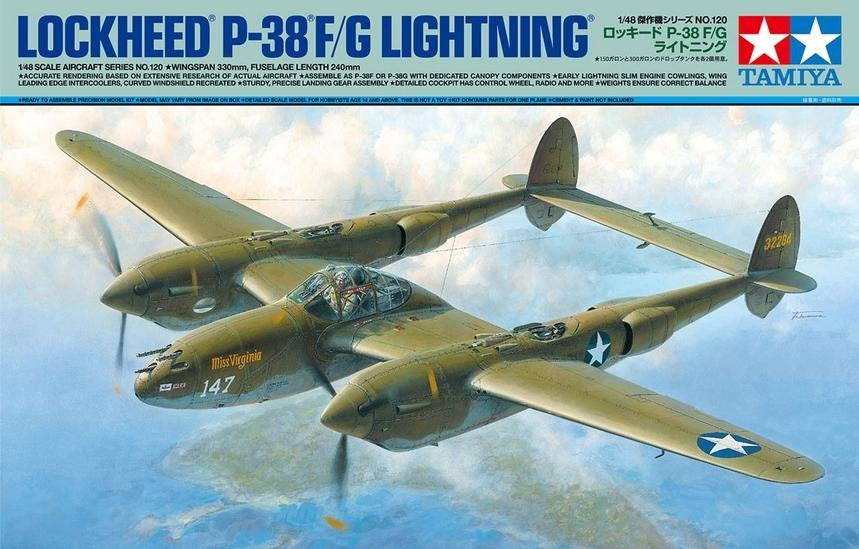
This WWII fighter was a daring design with twin booms and a piston engine in each, plus a central nacelle which housed the cockpit and armament (machine guns and cannon in the nose). Introduced in June 1941, the aircraft went on to be used extensively in the Pacific through WWII. The F variant was manufactured from April 1942 onward, and featured pylons for 150-gallon drop tanks to make it capable of longer bombing missions. Later P-38Gs had more powerful engines and could carry bigger 300-gallon drop tanks. The P-38 was used for interception, dive bombing, level bombing, ground attack, night fighting, photo reconnaissance, radar and visual pathfinding for bombers and evacuation missions, and extensively as a long-range escort fighter when equipped with drop tanks under its wings.
1/48 scale plastic model assembly kit. Fuselage length: 240mm, wingspan: 330mm.
P-38F and P-38G variants can be built.
The model creates a parked aircraft when assembled and complete.
Features accurate depictions of early P-38 features such as slimline engine cowlings, intercoolers in leading edges, plus the curved canopy front.
Weights are included in the kit to ensure correct balance of the model when displayed.
The canopy can be assembled open or closed. When closed, it is a 1-part slide-molded piece with dedicated F and G variant parts. The hatch is shown open sideways on the P-38F, and vertically on the P-38G.
A detailed cockpit features the wheel-type controls, radio, throttle box and more.
Comes with parts to recreate two each of 150- and 300-gallon drop tanks.
Includes two marking options: _x009c_White 147 _x009d_ P-38G which took part in the interception of Admiral Isoroku Yamamoto in April 1943 and _x009c_White 33 _x009d_ P-38F
Mirror stickers are included to recreate cockpit mirror and engine cowling interior surface sections.
Comes with canopy masking stickers and a full-color painting guide.
Skip to product information
The story behind your model New guide preview
P-38F/G: two engines, two tails
The Lightning looked unlike the single-engine fighters around it. Two Allison engines occupied separate booms, with the pilot and a concentrated battery of four .50-calibre machine guns and a 20 mm cannon in a central nacelle. Lockheed developed the design for a high-altitude interception requirement, and the prototype flew in January 1939. The arrangement gave the P-38 its unmistakable outline and left the nose free of a propeller.
Read the full story
The F and G were early combat Lightnings, before the later J-model’s deeper radiator cowls. Underwing fuel tanks helped turn the design’s range into an operational advantage. These aircraft fought across widely separated theatres, with the Pacific’s vast distances making long-range fighters especially valuable. The kit preserves the early slim engine-cowling shape and offers the different canopy arrangements associated with its F and G subjects.
Both included schemes connect the model to the Pacific war. White 33 represents a 39th Fighter Squadron aircraft at Port Moresby in late 1942. White 147, Miss Virginia, depicts a P-38G associated with Operation Vengeance in April 1943, when Lightnings intercepted the formation carrying Admiral Isoroku Yamamoto near Bougainville. Its asymmetric pair of drop tanks is a particularly telling detail: the mission demanded careful fuel planning as well as precise navigation.
Sources and accuracy
Tamiya 61120 instructions; Tamiya 61120 colour and history leaflet; Smithsonian: Lightning development and service
Kit Instruction Colors
View kit instructions (PDF)View painting and marking guide
![]() Find a Similar Color
![]() Find a Similar Color
![]() Find a Similar Color
![]() Find a Similar Color
![]() Find a Similar Color
![]() Find a Similar Color
![]() Find a Similar Color
![]() Find a Similar Color
![]() Find a Similar Color
![]() Find a Similar Color
![]() Find a Similar Color
![]() Find a Similar Color
![]() Find a Similar Color
![]() Find a Similar Color
![]() Find a Similar Color
![]() Find a Similar Color
![]() Find a Similar Color
![]() Find a Similar Color
![]() Find a Similar Color
![]() Find a Similar Color
![]() Find a Similar Color
![]() Find a Similar Color
![]() Find a Similar Color
![]() Find a Similar Color
![]() Find a Similar Color
![]() Find a Similar Color
![]() Find a Similar Color
![]() Find a Similar Color
![]() Find a Similar Color
![]() Find a Similar Color
![]() Find a Similar Color
These are the kit manufacturer’s paint recommendations. Follow the exact instruction diagrams for placement, marking choices and mixes. They are separate from the historical palettes below.
Build This Aircraft
Official required-color list. Choose a version and follow the manual color mixes. Available primary paints start selected. Uncheck paints you already have and select any optional tools you need.
Paints (31)
0 items selected
Tools and supplies (8)
Select any tools you need to add them with your paint selection.
Checking supply availability…
Paints and supplies sold separately. Prices and availability update from each product.
Historical Paint Schemes
Choose a documented aircraft or vehicle finish, then a paint system. These researched alternatives are separate from the instruction list above.
Each pack is its own shopping list. Choose one paint system; selections stay separate. Out-of-stock items remain visible but cannot be added. There is no bundle discount.
Exterior scheme colors only. Check the diagrams for pattern and placement. Interior, crew, small details and decals are not included unless a pack explicitly says so. Model paints are manufacturer-intended reproductions or labeled approximations, not independently measured exact historical matches.
Sources and accuracy
Tools for this build
Practical suggestions for assembling and finishing this kit. Buy only what you need; nothing here is added automatically.
Build basics
Loading current prices and availability…
Useful extras · optional
Loading current prices and availability…
Choose glue for the material and thinner for the paint range. A shared base type alone does not guarantee different brands can be mixed together.


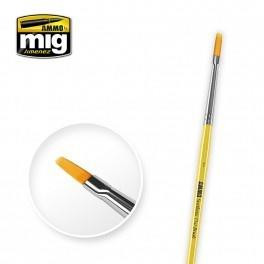
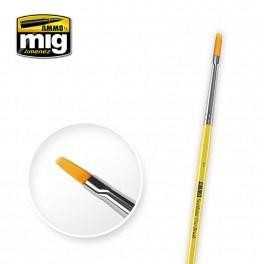
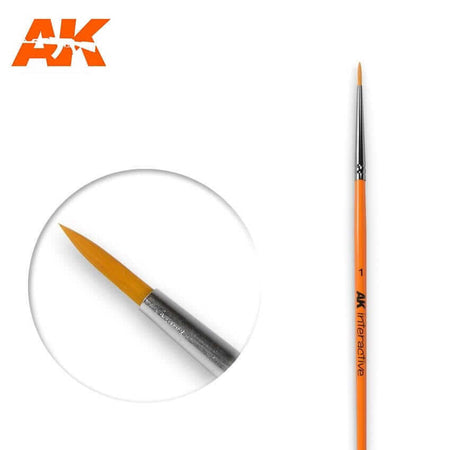




1/48 P-38F/G Lightning 61120
Regular price
$84.98