The Hien's narrow nose made it stand apart from the radial-engined Japanese fighters familiar to Allied pilots. Kawasaki used the Ha-40, a Japanese-built development of the Daimler-Benz DB 601 liquid-cooled engine, but the airframe itself was Japanese. Early Allied guesses about German or Italian origins helped produce its reporting name, Tony. The design offered a different balance of speed, protection and manoeuvrability, including armour and self-sealing tanks, rather than pursuing the lightest possible fighter.
Read the full story
This kit represents the Ki-61-Id, whose nose was lengthened by 20 centimetres to accommodate two Japanese 20 mm cannon. A pair of 12.7 mm guns remained in the wings. Production began in 1944, and the Id became the most numerous Hien variant. Its armament made it relevant to Japan's increasingly urgent air-defence effort as B-29 raids brought high-altitude combat to the home islands, though engine and support difficulties continued to constrain the wider Hien force.
The markings supplied by Tamiya offer contrasting snapshots of that service. Chofu-based 244th Air Group machines carried conspicuous red tails and unit markings over natural metal, sometimes with green mottling, while the 19th Air Group option in the Philippines wore dark-green upper surfaces. The featured Takashima aircraft combines a bare-metal foundation with irregular green camouflage. Keeping the pattern, tail colour and date together gives the model an individual identity, rather than treating every Hien as the same mottled aircraft.
Sources and accuracy
Tamiya 60789 original instruction manual; Military Aviation Museum: Kawasaki Ki-61-Ib; Tamiya Ki-61-Id historical background leaflet; Tamiya 60789 variant and markings overview
These are the kit manufacturer’s paint recommendations. Follow the exact instruction diagrams for placement, marking choices and mixes. They are separate from the historical palettes below.
Build this Aircraft
This list follows the color codes in the 60789 kit instructions. The linked bottled X/XF paints are Tamiya acrylics; the marking insert specifically recommends enamel paint for the mottled camouflage. Acrylic XF-13 is a paint-system alternative, so use application guidance for that range. Follow the exact diagrams for placement, markings and mixes; apply the indicated decals before the camouflage.
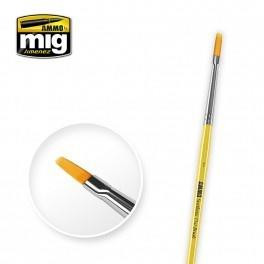
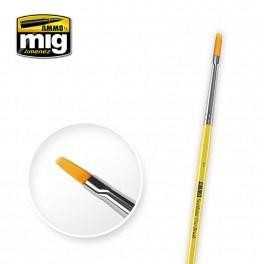
Select any tools you need to add them with your paint selection.
Checking supply availability…
Paints and supplies sold separately. Prices and availability update from each product.
Historical Paint Schemes
Choose a documented aircraft or vehicle finish, then a paint system. These researched alternatives are separate from the instruction list above.
Each pack is its own shopping list. Choose one paint system; selections stay separate. Out-of-stock items remain visible but cannot be added. There is no bundle discount.
Exterior scheme colors only. Check the diagrams for pattern and placement. Interior, crew, small details and decals are not included unless a pack explicitly says so. Model paints are manufacturer-intended reproductions or labeled approximations, not independently measured exact historical matches.
Sources and accuracy
Tools for this build
Practical suggestions for assembling and finishing this kit. Buy only what you need; nothing here is added automatically.
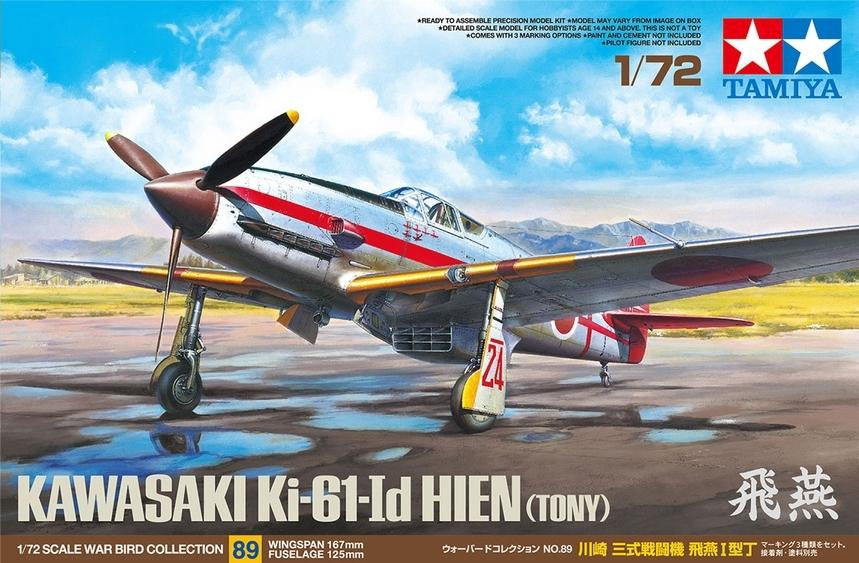
This scale plastic model kit accurately depicts the Kawasaki Ki-61-Id Hien. The Hien was officially adopted by the Imperial Japanese Army in 1943, and stood out among its Japanese aircraft contemporaries in the Pacific War on account of its liquid-cooled Ha-40 engine, slimline fuselage and long, elegant wing. A number of different variants were produced, among them the Ki-61-Id which featured a 20cm-elongated nose to house 20mm cannons, plus 12.7mm machine guns in the wing. In fact, with 1,360 units it was the most prolifically produced Hien variant; its superior performance at higher altitudes meant that it was often given the brief of taking on incoming U.S. B29 bombers in the skies around the home islands of Japan.
1/72 scale plastic model assembly kit. Approx. length: 125mm, approx. wingspan: 167mm. The model accurately depicts the Ki-61-Id Hien with elongated nose and slimline fuselage. The cockpit parts breakdown is changed from its 1/48 scale counterpart, and can be pre-assembled then slotted into the already-built fuselage sides. The fuselage underside radiator/oil cooler is artfully recreated with a single piece. One-piece canopy offers excellent fit with fuselage. Clear parts are included to recreate light and gun sight components. Optional Venturi tube and fuel cooler parts are included. Comes with 3 marking options, including the colorful tones of the 244th Air Group.